Build a Both Teams to Score Prediction App With ChatGPT: A Step-by-Step Gambling Nerd Guide
A 3–0 win and a 2–1 win both deliver over 2.5 goal

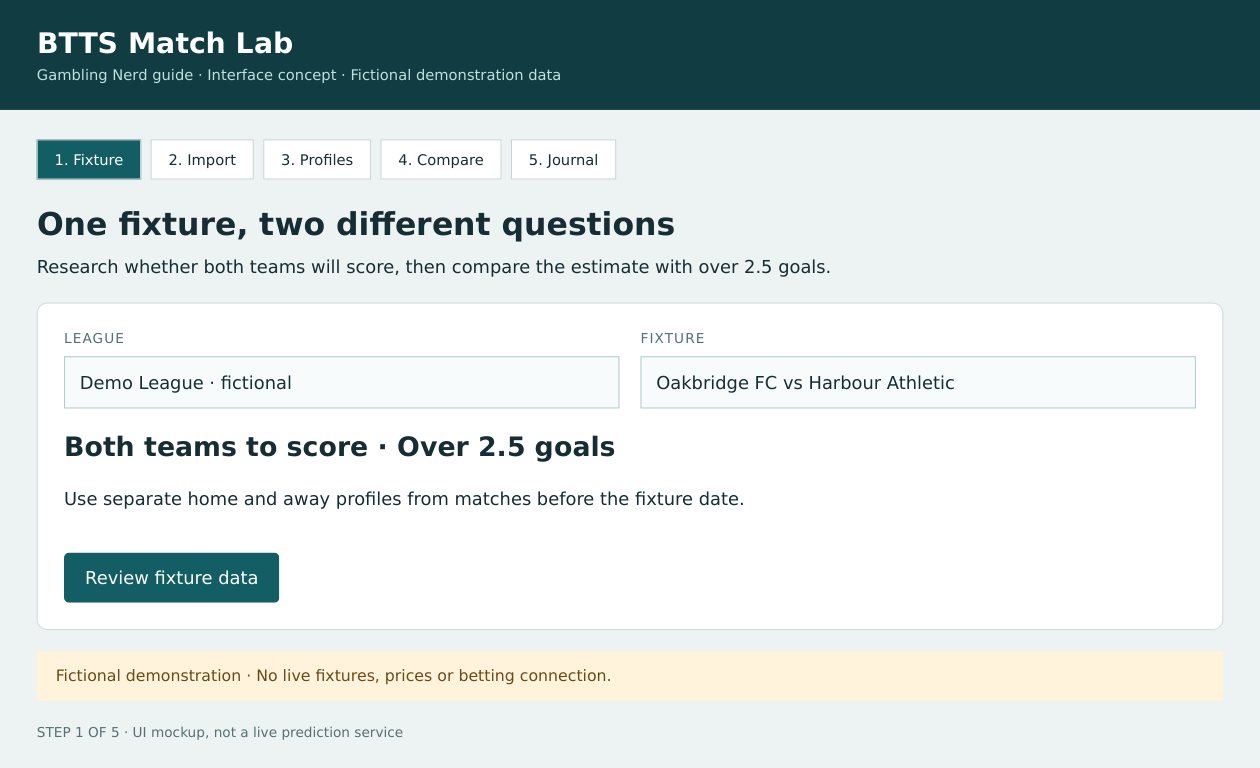
A 3–0 win and a 2–1 win both deliver over 2.5 goals. Only one delivers a winning both teams to score bet. That difference is easy to understand when the results are in, but easier to overlook when researching a fixture with a strong attacking favourite.
TalkFootball covers both teams to score, over 2.5 goals and match-result predictions. Building your own app lets you explore how those markets differ, using historical results and calculations you can inspect.
This Gambling Nerd guide explains how to use ChatGPT to build a simple BTTS research app. It will compare each team’s scoring and conceding records, produce an experimental probability estimate and track how its forecasts perform.
The interface previews use fictional teams and demonstration figures. They illustrate the proposed app’s appearance, rather than showing a live prediction service.
Step 1: Define the App Before Asking for Code
Start with one league and two related markets: both teams to score and over 2.5 goals.
BTTS Yes requires each side to score at least once. Over 2.5 goals requires at least three goals between them. For this project, use standard league results after 90 minutes plus stoppage time.
| Final score | BTTS Yes | Over 2.5 goals |
|---|---|---|
| 1–1 | Wins | Loses |
| 3–0 | Loses | Wins |
| 2–1 | Wins | Wins |
| 1–0 | Loses | Loses |
Open a new ChatGPT conversation and explain that you want to build a beginner-friendly research app called BTTS Match Lab. Ask for one self-contained HTML file with embedded CSS and JavaScript, which you can save and open in a browser.
Describe five sections: fixture selection, results importing, home and away profiles, market comparison and a prediction journal. Ask ChatGPT to build the layout and navigation first, then add the calculations as you work through the guide.
Specify that the app should use manually imported data, with no paid APIs or bookmaker connections. Fictional examples must remain clearly labelled and separate from real results.
Ask ChatGPT to explain how to save its output as btts-match-lab.html. Open the file in your browser and check the navigation before proceeding.
Keep the same conversation for subsequent changes. After each stage, request the complete updated HTML file so you can replace the previous version without combining scattered code fragments.
Start with a selected fixture and two clearly defined markets.
Step 2: Import Full-Time Results and Check Them
The app needs dates, team names and full-time scores. You can begin with a completed Premier League season from Football-Data’s English results archive, which provides downloadable season CSV files and notes explaining their fields.
The essential columns are:
| Source field | Information |
|---|---|
| Date | Match date |
| HomeTeam | Home team |
| AwayTeam | Away team |
| FTHG | Full-time home goals |
| FTAG | Full-time away goals |
Download the file and preserve an unchanged copy.
Ask ChatGPT to add a CSV importer supporting these fields. It should handle quoted values, parse the source’s date format explicitly and display a preview before accepting the import.
Request checks for missing team names, invalid dates, duplicate fixtures and goal values that are missing, negative or not whole numbers. Tell ChatGPT explicitly that a blank score must never become zero. An unknown result and a recorded 0–0 draw are different things.
Next, define which matches the app may use. For any selected fixture, only results from earlier calendar dates should contribute to its profiles. Exclude same-day matches initially, since the file may not establish exactly when their results became available.
Ask the app to display the source URL, download date, accepted rows and excluded rows, with reasons for exclusions. Keep different leagues separate.
Before moving on, compare several imported matches with the original CSV. A date-parsing error can quietly put later results into an earlier forecast, making a historical test look better than it really is.
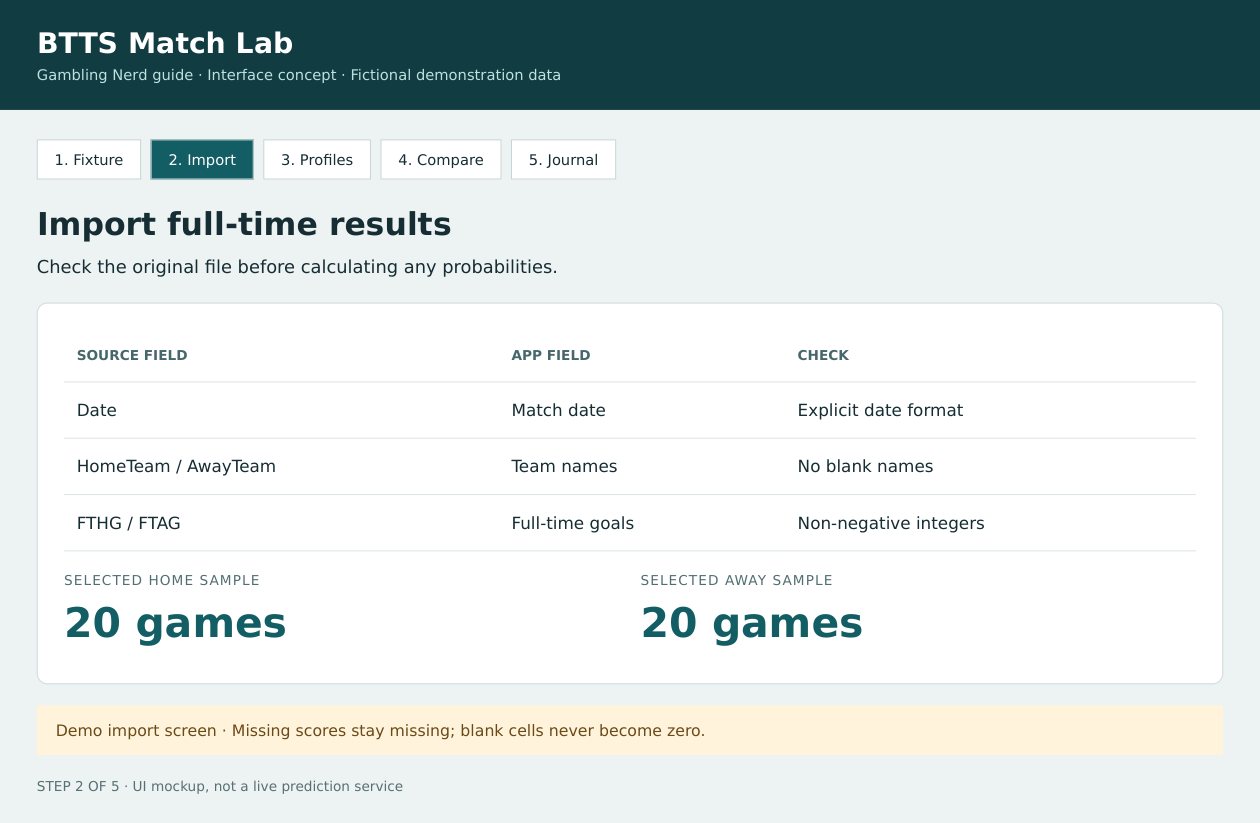
Check the imported fields before using them in a model.
Step 3: Examine Both Attacks and Both Defences
A strong home attack can support a high total-goals estimate without making the away team likely to score.
To capture that distinction, ask ChatGPT to create separate profiles using the home team’s latest 20 eligible home league matches and the visitor’s latest 20 eligible away league matches.
Each profile should show goals scored and conceded, per-match averages, clean sheets, failures to score and historical BTTS frequency. Display the actual match count and date range alongside those figures.
Use 20 matches as a starting window, rather than treating it as an established optimum. Ask for a limited-sample warning below 20 matches and withhold estimates below ten. Those are practical prototype settings that you can later evaluate.
For our fictional fixture, Oakbridge FC hosts Harbour Athletic.
Oakbridge scored 50 goals and conceded 12 across its previous 20 home matches. Harbour scored 12 and conceded 50 across its previous 20 away matches.
Oakbridge scored in 18 of those home games. Harbour scored in only nine of its away games. Harbour’s 11 failures to score deserve attention even though its defence regularly conceded goals.
Ask ChatGPT to display these profiles on opposite sides of a pitch-inspired panel. Keep the figures readable and label them as historical observations.
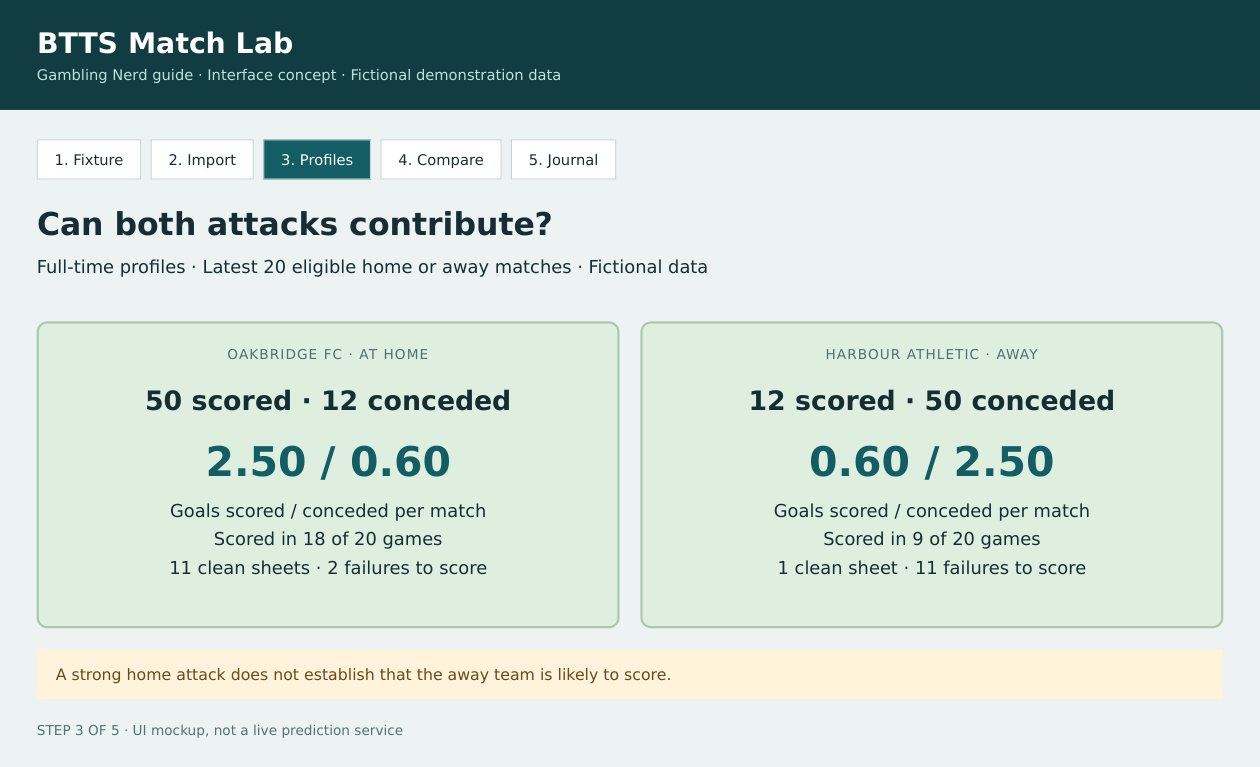
The visitor’s scoring record matters as much as the favourite’s attacking strength.
Step 4: Calculate BTTS and Over 2.5 Separately
The first model should be simple enough to explain.
Ask ChatGPT to estimate the home team’s goals by averaging its home scoring rate with the away team’s away conceding rate. Estimate away goals by averaging the visitor’s away scoring rate with the home side’s home conceding rate.
For the fictional fixture:
| Calculation | Expected goals |
|---|---|
| Oakbridge: average of 2.50 scored and 2.50 conceded by Harbour | 2.50 |
| Harbour: average of 0.60 scored and 0.60 conceded by Oakbridge | 0.60 |
| Combined expectation | 3.10 |
These are model expectations, not predicted exact scores.
Next, ask ChatGPT to implement an independent Poisson baseline. Under this model, a team with an expected scoring count of λ has a probability of scoring at least once equal to 1 − e⁻λ.
For BTTS, multiply the two teams’ probabilities of scoring:
BTTS probability = (1 − e⁻²·⁵) × (1 − e⁻⁰·⁶) ≈ 41.4%
For over 2.5 goals, calculate the probability of at least three total goals using the combined expectation:
Over 2.5 probability = 1 − e⁻³·¹ × (1 + 3.1 + 3.1² ÷ 2) ≈ 59.9%
The difference tells a useful story. The model gives Oakbridge enough attacking strength to lift the total-goals estimate, while Harbour’s low scoring expectation holds BTTS down.
A 3–0 result would satisfy over 2.5 goals while losing BTTS Yes. That is an illustration of the distinction, not an exact-score prediction.
Make the Assumptions Visible
Tell ChatGPT to display both teams’ expected goals, the formulas and the resulting percentages. Retain full precision internally and round only for display.
Label the method as an experimental baseline. It assumes independent scoring counts and does not adjust for opponent strength, lineups, tactical changes or how scoring behaviour changes during a match.
Ask ChatGPT to check the calculations against the example: expected goals of 2.50 and 0.60 should produce approximately 41.4% BTTS and 59.9% over 2.5. Swapping the teams’ expected goals should leave both market probabilities unchanged. Missing inputs should produce no estimate.
Also request a small scoreline grid showing how 1–1, 3–0, 2–1 and 1–0 settle each market.
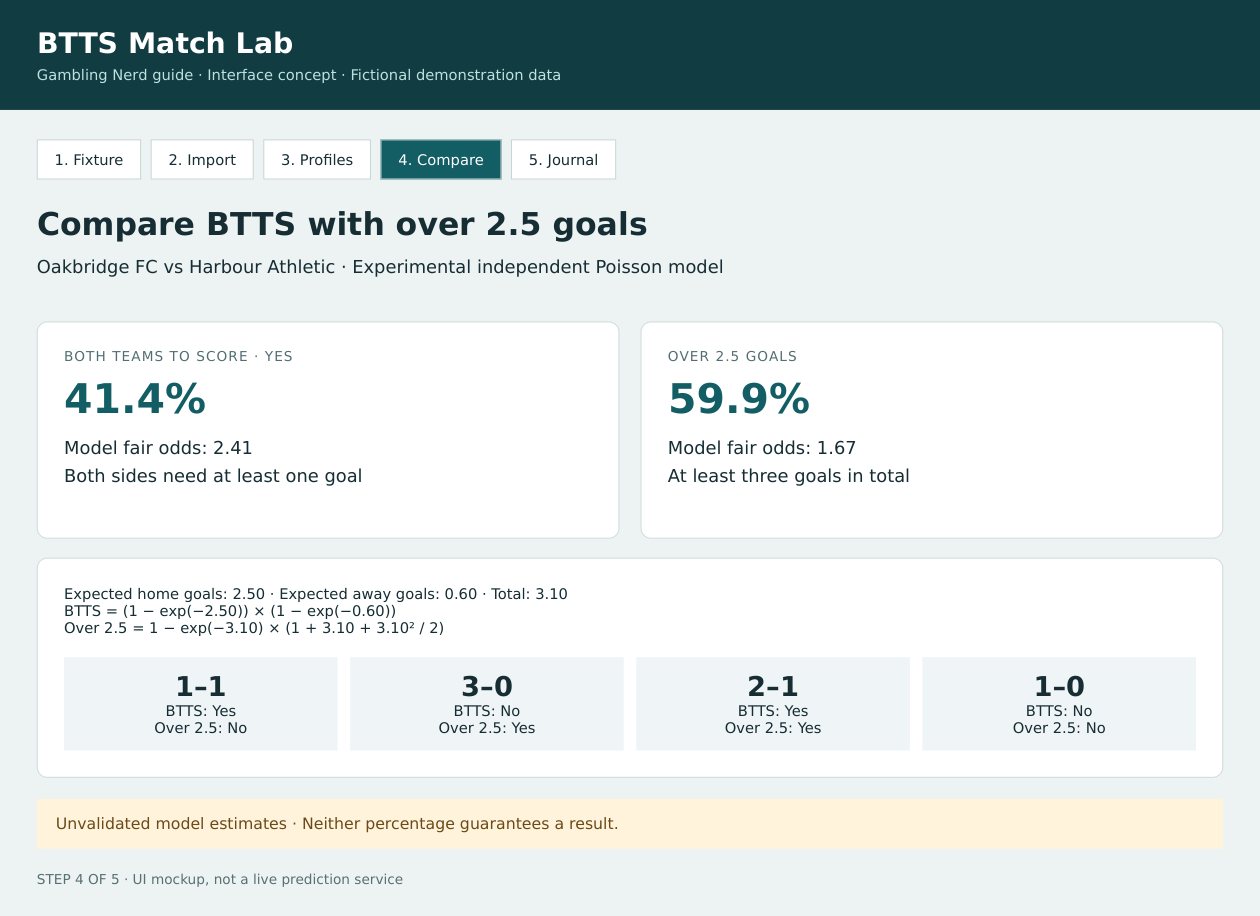
The two markets can produce substantially different estimates for the same fixture.
Add an Optional Price Comparison
Ask ChatGPT to add separate manual decimal-odds fields for BTTS Yes and over 2.5 goals. Each field should identify its market, price source and observation time.
The app can calculate model fair odds by dividing one by the estimated probability. Our example produces approximately 2.41 for BTTS Yes and 1.67 for over 2.5 goals.
Suppose BTTS Yes is available at 2.10. That price requires a success rate of approximately 47.6% to break even, above the model’s 41.4% estimate.
Tell ChatGPT to show this comparison without calling a favourable difference a proven edge. Any apparent value depends on whether the underlying probability estimate is accurate.
Step 5: Save Forecasts and Settle Both Markets
An app needs a record of what it predicted before the result arrived.
Ask ChatGPT to add a journal using local browser storage, with JSON export and import for backups. Preserve the fixture, actual creation timestamp, model version, source details, sample sizes, unrounded probabilities and any recorded odds.
Keep saved forecasts unchanged. Final scores should be added later through separate settlement fields.
For BTTS, the outcome is Yes when both teams score at least once. For over 2.5, it is Yes when the combined score reaches three or more.
Ask the journal to distinguish prospective predictions, historical reconstructions and fictional demonstrations. A historical calculation created today should never appear to have been published before an old fixture.
Request separate binary Brier scores for the two markets. This measure averages the squared difference between a forecast probability and its eventual outcome, recorded as one for Yes and zero for No. Lower scores are better.
GamblingNerd.com’s explanation of why probability-based bets can still lose provides useful context here. An individual result cannot establish whether a probability estimate was sound, and losing a forecast does not by itself prove the method was wrong.
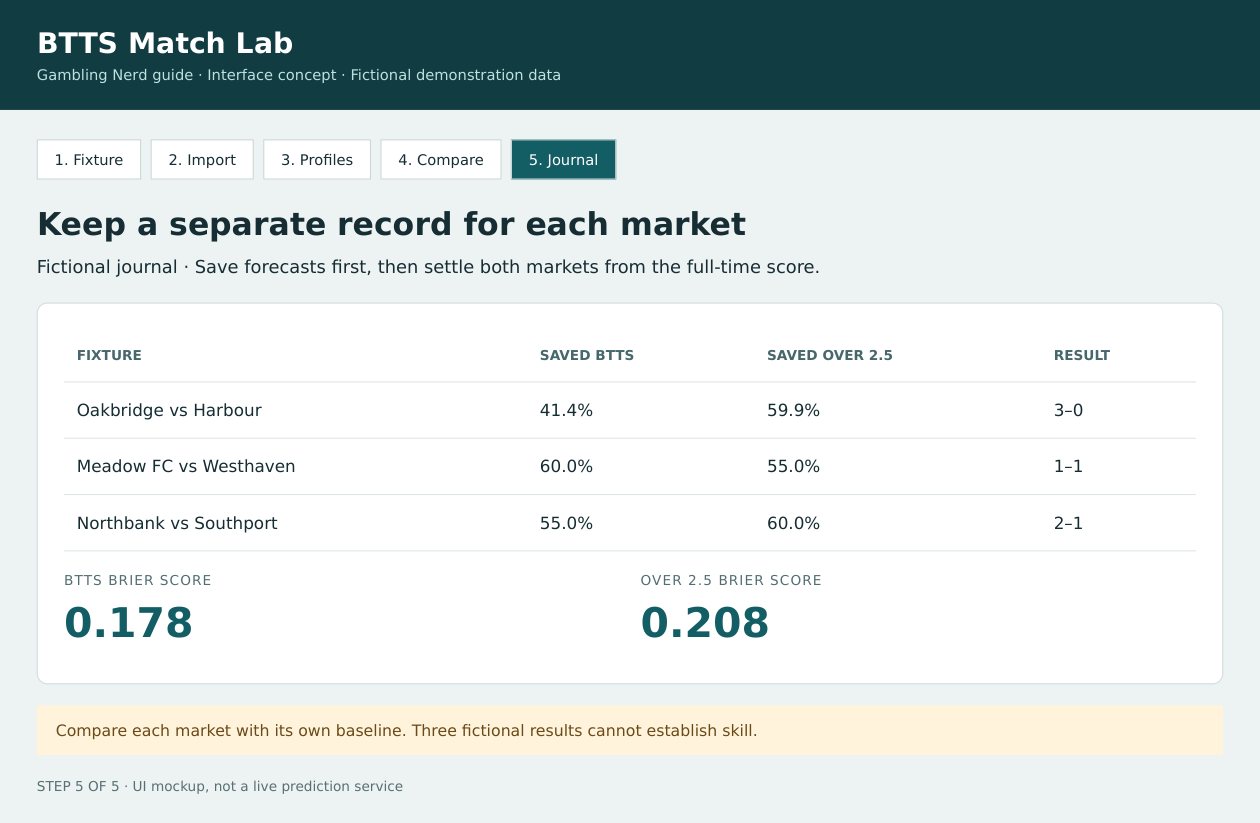
The three fictional results demonstrate settlement and scoring, rather than forecasting skill.
Test Each Market Against Its Own Benchmark
Your BTTS model needs a BTTS benchmark. Your over 2.5 model needs an over 2.5 benchmark.
Ask ChatGPT to calculate each league’s historical frequency for the relevant event using only results available before the fixture being tested. Those frequencies become simple baseline forecasts.
Then request a chronological evaluation. For each eligible match, the app should rebuild the team profiles and league benchmarks using earlier results only, save the forecasts and subsequently assess the outcomes.
Evaluate model and benchmark on identical fixtures. Display sample size, date range, excluded matches and average Brier scores separately for each market.
Do not use the journal’s two scores to conclude that BTTS is inherently easier to predict. The markets have different underlying frequencies. The useful question is whether each model improves on its own appropriate benchmark.
Keep settings fixed during a test. If reviewing the results leads you to change the historical window or calculation, evaluate the revised version on a fresh period.
Use the first few weeks of prospective forecasts to check that imports, timestamps and settlement work correctly. Forecasting accuracy requires broader evaluation. Testing profitability additionally requires reliable prices for each exact market at the time those prices were available.
Improve the Explanation Before Adding More Features
Once the baseline works, you can investigate opponent-strength adjustments, different historical windows or methods that pull small samples towards league averages.
Save each revision as a new model version. Add features when they improve testing results or make the evidence easier to understand.
The app should also be comfortable showing “insufficient data.” A percentage is less useful when its inputs are missing or its sample is too thin.
The main benefit of building this tool is being able to inspect the reasoning behind a forecast. When a match looks promising for goals, the app gives you a structured way to examine whether both teams are likely to contribute.
About the Author
Gambling Nerd is an independent gambling media website publishing experience-based reviews, guides and analysis of online casinos, sportsbooks and poker sites. Originally launched as gamblingsites.org in 2007 and rebranded as GamblingNerd.com in 2025, its US-based editorial team serves readers worldwide. Its Nerd Nook Hub explores gambling mathematics, betting systems and sports betting strategy.